Yuki asamura - sound artist
Part of The Psithur Project
On lichens and sound art
In this week’s author and artist focus, sound artist Yuki Asamura enters the world of flora and fauna and discusses its indelible influence on his sound art.
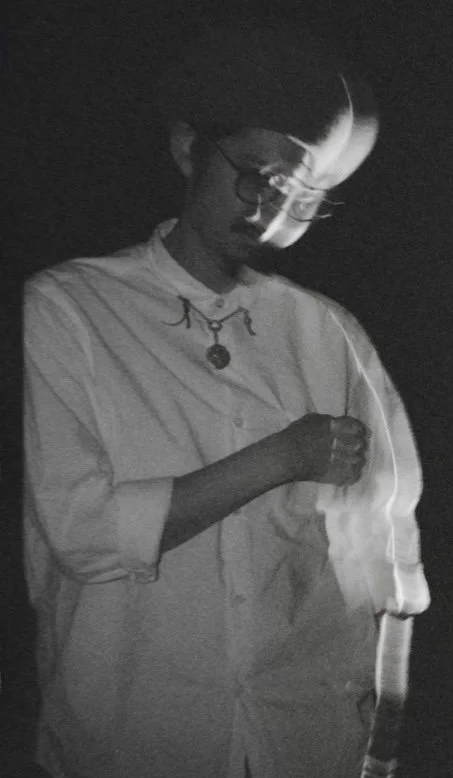
Yuki Asamura, sound artist and field recordist, contributor to The Psithur Project
Lichens and the boundaries of life
In a forest, trees are connected to other forms of life through mycorrhizal networks, while lichens themselves exist through the symbiosis of multiple organisms. The more I learn about fungi and plants, the more I have come to realise that the boundaries of life are far more ambiguous than I once imagined—where a life begins, and where it ends. I have come to feel that life and its environment are shaped not so much by the individual itself, but by the relationships that emerge in between.
Lichens inhabit rocks, trees, and some of the most extreme environments on Earth [and it’s their'] almost invisible and extremely slow existence [which] resonates deeply with my practice of listening to subtle sounds and traces that might otherwise remain unnoticed.’
Listening to relationships
Through field recording and real-time soundscape creation, I try to listen not only to individual sounds, but to the relationships within an entire environment: water, wind, humidity, terrain, plants, microorganisms, and other presences that shape a place. A single sound never exists entirely on its own; it emerges through countless interactions between living beings and their surroundings.
Rather than trying to ‘turn lichens into sound,’ I am interested in listening to the time they inhabit, the environments they live within, and the invisible relationships extending around them. For me, this is also a way of listening to the space between existence and environment—something I continue to explore through sound.
Time, space, and sound
This awareness has also transformed my relationship with time, space, and sound. Time does not flow at a single, constant pace, nor is space a fixed container. Life, matter, climate, and countless other elements interact, giving rise to a different state in every moment.
For me, creating soundscapes is an act of listening to these connections between life and environment that often lie beyond our ordinary perception, while recognising myself as part of them. Continuing to explore, through sound, the sensations and inner movements that arise from this experience has become fundamental to my practice.
—Yuki